Sourcing from China
China Product Sourcing:
How to Find, Meet
& Verify Suppliers
Start with a clear product brief. Find and compare potential suppliers.
Screen the shortlist, meet the right people, and verify before you commit.
A practical guide for overseas buyers, with China-side support where it counts.

- DefineProduct & requirements
- Discover & compareCandidates & evidence
- Meet & verifyQuestions & checks
- You decideSupplier & commitment
01 / Prepare
A better search starts
with a better brief.
China product sourcing is a sequence of decisions, not a single supplier search. Before you source from China, give every candidate the same requirements. Otherwise, you may be comparing different products disguised as different prices.
Know what you need.
Then ask who can make it.
A catalogue image is a starting point. Add materials, dimensions, tolerances, intended use and packaging so suppliers can respond to the product you actually want.
Separate non-negotiable requirements from preferences. Tell suppliers what is still undecided instead of letting them fill the gaps for you.
Download the sourcing briefAn editable text worksheet. Keep it with your project notes and use it for supplier enquiries.
Tick the information you already have. This is a preparation checklist, not supplier approval.
Checked items reset when you reload. Nothing is sent to QGO.
02 / Find
Different channels.
The same need for evidence.
You can find suppliers in China through trade shows, online marketplaces, referrals and industry clusters. Use each channel to discover candidates; assess each company against your brief.
Trade shows
Canton Fair & industry events
Compare products in person, ask specific questions and collect the company name behind each booth. Use relevant industry shows as well as broad fairs.
A booth and a good conversation do not prove who manufactures your product. Request the production address and confirm whether a follow-up visit is possible.
First-time Canton Fair guideExport marketplaces
Alibaba · Made-in-China · Global Sources
Search your product category, review profiles and send the same brief to a manageable group of candidates. Global Sources also connects online discovery with trade shows.
Read the underlying assessment where available. A platform badge can describe specific checks; it does not establish that your exact product, capacity or order requirements have been independently verified.
Domestic platforms
1688
Explore a marketplace focused on Chinese domestic wholesale. It can help you understand product options, but Chinese-language communication adds friction for overseas buyers.
Ask about export capability, documentation and the quoted delivery basis. A domestic listing price is not a complete landed-cost comparison for your destination.
Referrals & clusters
Industry contacts · local networks
Use relevant introductions and supplier locations to build a more focused search. A referral can open a conversation; it still needs to fit your product and order.
Confirm the legal company, the actual production location and who is introducing whom. Proximity to an industry cluster is not proof of production capability.
How to Find a Manufacturer in China: Search Terms & First Enquiries
Platform sources & scope of this guide
Channel descriptions refer to the platforms’ own information: Alibaba Verified Supplier, Made-in-China, Global Sources verification processes and Alibaba Group: 1688. Platform features can change. This guide is preparation guidance, not a recommendation of individual suppliers.
03 / Compare
Build a shortlist.
Not a folder of quotations.
Start with several candidates, then narrow to a working shortlist of 3–5 serious options. That is a useful comparison size, not a requirement or a guarantee that every product has five suitable suppliers.
Ask everyone the same questions.
Get the comparison sheetProduct fit
Can they make your specification, or are they offering the closest catalogue item? Record differences explicitly.
Company & production role
Which entity would you buy from? What does it make itself, and what is outsourced? Ask for the production location.
Quantity, samples & timing
Compare minimum order quantity, sample cost and lead time, and the supplier’s proposed production schedule.
Documents & market fit
List the documents relevant to your product and destination. Check entity, product coverage and validity with the appropriate provider.
Quotation basis & open questions
Use the same specification, packaging, currency and delivery basis. Record exclusions, unanswered questions and the next action.
Before you book travel
Screen the supplier you plan to meet.
Preliminary screening helps you decide whether to spend visit time on a candidate. QGO’s existing service can include an initial shortlist of 3–5 potential suppliers where required, plus one detailed pre-visit screening report for one selected supplier, under the confirmed scope.
A shortlist is not supplier approval. Additional detailed reports and third-party work are separately scoped.
04 / Meet
Travel with questions.
Leave with better information.
A China visit is useful when there is something specific to resolve: a complex specification, a sample to discuss, a production claim to understand, or several shortlisted companies to compare.
Give each meeting a purpose.
Confirm the address, host and agenda before travelling. Send your product brief ahead, bring reference samples or drawings, and list the unanswered questions that matter to your decision.
During the meeting, distinguish a supplier’s explanation from what you observe. Afterwards, send a written recap of open items, responsible people and the next step.
One region.
Several possible stops.
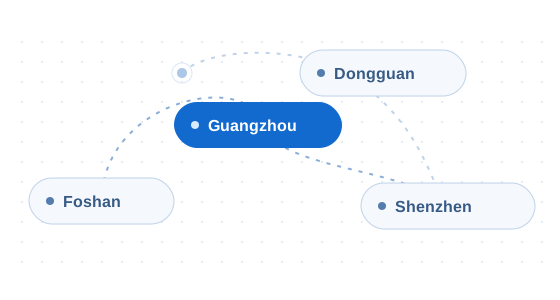
Guangzhou, Foshan, Dongguan and Shenzhen can be part of the same sourcing trip. Let the shortlisted suppliers’ actual addresses shape the route; avoid adding cities just to fill a schedule.
Plan a route from Guangzhou05 / Verify
Match the depth of the check
to the decision ahead.
Discovery gives you names. Screening helps prioritise meetings. A visit adds context. Before you order, contract or make a substantial payment, decide what further verification your product and transaction require.
A candidate
Fits the brief on paper.
Still a set of supplier claims.A meeting priority
Preliminary records and documents reviewed.
Screening is an early filter.A better-informed option
Questions discussed; observations recorded.
A visit adds context, not certification.A buyer decision
Further checks and qualified advice as needed.
The purchasing decision remains yours.Do the names and evidence line up?
If the selling company, production site, documents or proposed payment recipient do not line up, pause and clarify. Treat unresolved questions as a reason for further checks, not an inconvenience to work around.
Deeper supplier verification, independent product testing, quality inspection and legal review serve different purposes. Confirm the scope with the appropriate provider.
06 / China-side support
Your sourcing decisions.
QGO’s local coordination.
Sourcing goods from China often needs more than a search result: supplier outreach, a confirmed meeting, an interpreter and a workable route. QGO supports that China-side preparation and visit execution within the agreed scope.
Where QGO can support you
- Supplier search and a preliminary shortlist, where required.
- Pre-visit screening and supplier communication.
- Meeting and factory-visit coordination.
- Interpreters, vehicles and route preparation.
- Coordination of further verification or qualified third-party support within the confirmed scope.
Where responsibility stays with you
- Final supplier selection and purchasing decisions.
- Price and contract negotiation.
- Purchase execution, order follow-up and production management.
- Qualified legal advice, independent audits and quality inspection.
- Transaction risk and commercial outcomes.
QGO is a China-side business support and supplier coordination provider, not a purchasing agent, accredited factory auditor, quality inspector or legal adviser. Services and final arrangements require written confirmation. QGO does not guarantee supplier performance or transaction outcomes.